
Use this calculator to estimate the bending force required for air bending sheet metal and plate. Enter the material type, material thickness, bend length and V-die opening to calculate the approximate tonnage required and the suggested minimum press brake size.
This calculator is intended as a practical guide only. Final machine selection should also consider tooling, material grade, flange size, bend radius, throat depth, open height, stroke, crowning system and production requirements.
Calculate Required Press Brake Tonnage
How to work out the V-die opening
The V-die opening is the width across the top of the bottom die. In air bending, this is usually selected based on the material thickness.
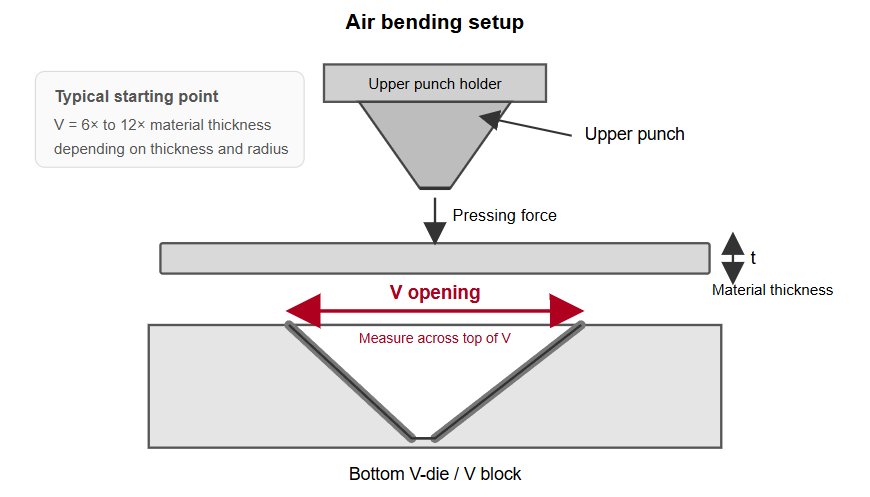
General guide for air bending
| Material thickness | Typical V opening | Example |
|---|---|---|
| 1–3 mm | 6 × thickness | 3 mm plate → 18 mm V |
| 4–8 mm | 8 × thickness | 6 mm plate → 48 mm V |
| 10 mm and above | 10–12 × thickness | 10 mm plate → 100–120 mm V |
Air bending, bottoming and coining explained
This calculator is based on air bending, which is the most common method used on modern CNC press brakes. Air bending is generally the best method for most fabrication work because it is flexible, efficient and requires less tonnage than bottoming or coining.
Air bending
The punch pushes the material into the V-die without forcing it fully to the bottom of the die. The bend angle is controlled mainly by the punch depth. Air bending usually requires the lowest tonnage and allows different angles to be produced using the same tooling.
Bottoming
The material is pressed further into the die so it more closely follows the punch and die angle. Bottoming can improve angle consistency in some applications, but it generally requires much higher tonnage than air bending and depends heavily on the tooling geometry and material springback.
Coining
Coining uses very high force to plastically compress the material at the bend point. It can produce accurate bends with reduced springback, but it requires significantly higher tonnage and is normally used only for specialist applications, thin material or where a very precise bend is required.
Important note about tonnage
Bottoming and coining can require substantially higher tonnage than air bending. As a broad guide only, bottoming may require around 2 to 4 times the air bending force, while coining can require 5 to 10 times or more. Because this depends on material grade, punch radius, die angle, inside radius and the exact bending method, bottoming and coining should be confirmed from drawings and tooling details.
Typical press brake tooling supplied with our machines
The calculator above allows you to enter any V-die opening, which is important because the correct V opening depends on the material thickness, required bend radius and tooling available. As a guide, our machines are normally supplied with a standard punch and multi-V bottom die tooling set similar to the tooling shown below.
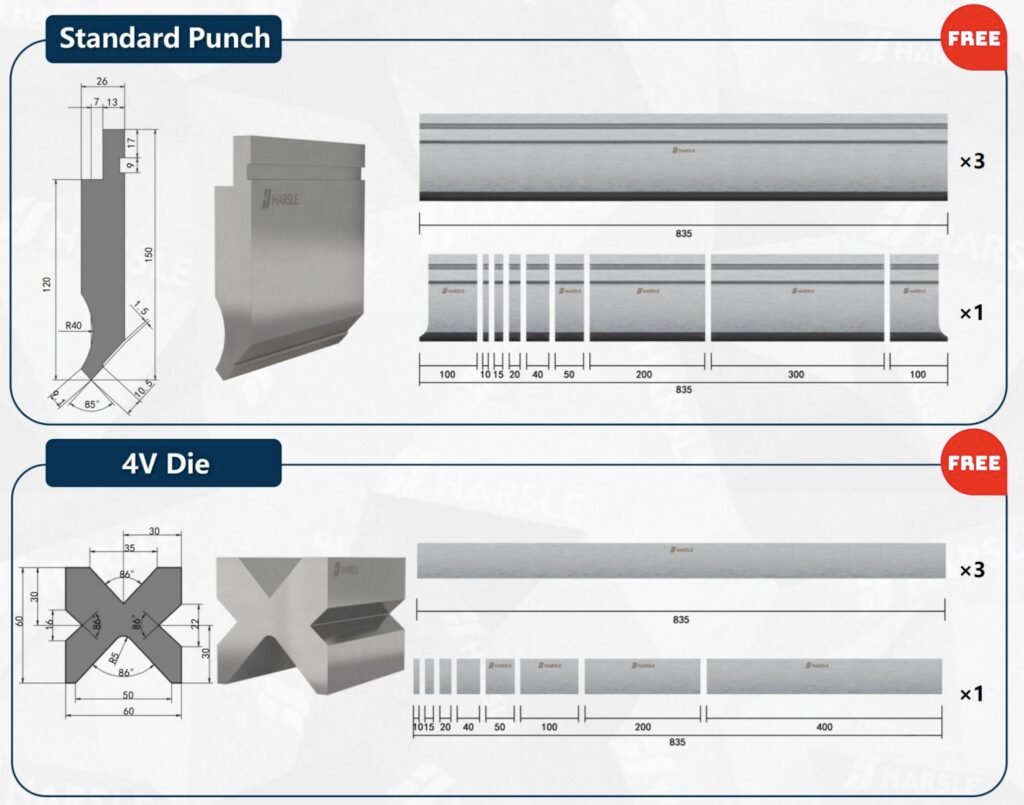
How this relates to the calculator
When using the calculator, enter the V opening you intend to use. If you are using the standard multi-V bottom die, choose the closest suitable V opening for the material thickness. If the required V opening is not available in the standard tooling set, we can quote additional tooling to suit the application.
What information do you need to size a press brake?
To size a press brake correctly, you need to know the material type, maximum material thickness, longest bend length, required bend angle, inside radius, flange sizes and the type of parts being produced. Drawings or sample photos are ideal because the part shape can affect tooling, throat depth, open height and stroke requirements.
How material type affects press brake tonnage
Different materials require different bending force. Mild steel is often used as the standard reference. Stainless steel generally requires more force than mild steel, while aluminium usually requires less force. Higher tensile materials can require substantially more tonnage and may also require special tooling consideration.
Why machine length matters
The press brake bed length should be longer than the longest bend you need to produce. For example, if the longest bend is close to 3000 mm, a 3200 mm press brake is commonly selected. However, the machine still needs enough tonnage across that full bending length.
When should you choose a larger press brake?
Choose a larger press brake when the calculated tonnage is close to the machine limit, when you frequently bend long parts, when you work with stainless or high tensile materials, or when you need flexibility for future work. A larger machine may also be helpful where tooling height, open height, throat depth or heavier production work is important.
Press brake sizing examples
Example 1: 6 mm mild steel, 3000 mm bend
Using a 48 mm V opening and a 20% safety margin, this type of application often points toward a machine around the 170 tonne × 3200 mm class, depending on the required bend radius and tooling.
Example 2: 10 mm mild steel, 3000 mm bend
Using a 100 mm V opening, this becomes a heavier application and may push the selection toward a larger press brake, particularly if the work is frequent or production based.
Example 3: Stainless steel bending
Stainless steel requires more bending force than mild steel, so a machine that is suitable for mild steel may not have enough capacity for the same thickness and length in stainless steel.
Need help selecting the correct press brake?
Send us your material type, maximum thickness, bend length, part drawings and production requirements. We can help recommend a suitable press brake size, tooling package, control system and backgauge configuration.
Press brake, folder or panel bender?
This calculator is designed for press brakes using an upper punch and lower V-die. Folders and panel benders use different bending methods, so they are selected using different criteria. The guide below helps explain when each type of machine is normally used.
Press brake
Best for general fabrication, thicker material, higher tonnage work, tighter bends, tooling flexibility and applications where different punches and dies are required.
Folder
Best for lighter sheet metal, long straight folds, large panels, flashings, covers, trays, guards, ducting and coated or finished materials.
Panel bender
Best for automated production of repeat panels, cabinets, doors, enclosures, boxes and parts with multiple bends where speed and repeatability are important.
Press brake sizing FAQ
What size press brake do I need?
The correct press brake size depends on the material type, material thickness, bend length, V-die opening and the type of parts being produced. As a starting point, calculate the required tonnage for the longest and thickest bend you need to make, then select a press brake with suitable tonnage, bed length, throat depth, open height and stroke.
How do I calculate press brake tonnage?
Press brake tonnage is usually calculated from the material tensile strength, material thickness, bend length and V-die opening. Thicker material, longer bends and smaller V openings require more tonnage.
What V-die opening should I use?
For air bending, the V-die opening is commonly selected as a multiple of the material thickness. As a guide, 1–3 mm material often uses around 6 times the material thickness, 4–8 mm material often uses around 8 times the thickness, and 10 mm or thicker material often uses around 10 to 12 times the thickness.
What is air bending?
Air bending is a common press brake bending method where the punch pushes the material into the V-die without forcing the material fully to the bottom of the die. The bend angle is controlled mainly by how far the punch travels into the V opening. Air bending usually requires less tonnage than bottoming or coining, and it allows a range of angles to be produced using the same tooling. The final bend result depends on material thickness, material grade, V-die opening, punch radius and springback.
What is bottoming?
Bottoming is a press brake bending method where the material is pressed further into the die so it more closely follows the punch and die angle. It generally requires more tonnage than air bending and is more dependent on the exact tooling geometry, material grade and springback.
What is coining?
Coining is a high-force bending method where the punch compresses the material at the bend point. It can reduce springback and produce accurate bends, but it requires much higher tonnage than air bending and is normally used only for specialist applications.
Is this calculator suitable for all bending jobs?
No. This calculator is intended as a guide for air bending only. It does not replace proper tooling selection or machine assessment. Bottoming, coining, hemming, special tooling, high-tensile material, short flanges and complex part shapes may require different calculations.
Does this calculator work for panel benders?
No. This calculator is designed for press brakes using air bending with an upper punch and lower V-die. A panel bender works differently. It normally clamps the sheet and bends the flange using a folding blade or beam. Panel bender selection is usually based on maximum sheet size, material thickness, flange height, bend complexity, automation requirements and the type of panels being produced.
Does this calculator work for folders?
No. This calculator is designed for press brakes using air bending with an upper punch and lower V-die. A sheet metal folder works differently. It clamps the material and bends the flange using a folding beam. Folder selection is usually based on material thickness, material type, folding length, flange height, open height and the style of parts being produced.
When should I use a folder instead of a press brake?
A folder is often the better choice for thin sheet metal, long flanges, coated material and large panels that are awkward to handle on a press brake. A press brake is usually the better choice for thicker material, higher tonnage work, tighter bend radii, complex tooling and general fabrication.
When should I use a panel bender instead of a press brake?
A panel bender is often the better choice when you are producing repeat sheet metal panels, cabinets, doors, enclosures, covers or box-style parts with multiple bends. Panel benders are designed for fast, repeatable production and can bend flanges up and down automatically while the sheet is clamped and supported. A press brake is usually the better choice for thicker material, higher tonnage work, one-off fabrication, complex tooling and more varied general fabrication jobs.
Can SMPS help me choose the correct press brake?
Yes. Send SMPS your material type, thickness, bend length, drawings and production requirements, and we can help recommend a suitable press brake size, tooling package, control system and backgauge configuration.
Recent Comments